How to Fix a Green Pool
You walk outside and the pool is green. Maybe it happened after a week away. Maybe it crept up over a few days while you were busy. Either way, the sight of it is unpleasant and the fix feels overwhelming. It's not. A green pool is a chemical problem with a chemical solution. Follow these steps in order and you'll have clear water within 3-5 days.
Green water means algae. Algae blooms when chlorine drops below effective levels and the water has enough warmth, sunlight, and nutrients (phosphates, nitrogen from debris) to feed growth. The fix is straightforward: kill the algae, remove it physically, and restore the chemical balance.
Before You Start: Assess the Severity
Not every green pool needs the same treatment. Here's a rough guide:
- Light green, still translucent. You can see the bottom of the pool. The chlorine probably dropped for a day or two. This is the easiest to fix. Standard shock treatment will sort it out.
- Dark green, murky. You can see about 30cm down. The algae has been growing for several days. You'll need a heavy shock, extended filtration, and brushing.
- Black-green, opaque. You cannot see the bottom at all. This has been neglected for weeks. Recovery is still possible, but you may need to repeat the shock treatment and run the filter for several days straight. If there's thick sludge on the bottom, vacuum to waste before shocking.
Step 1: Remove Debris
Before adding any chemicals, get the big stuff out. Leaves, twigs, dead insects, anything floating or sitting on the bottom. Use a leaf net or rake. Don't bother trying to vacuum at this point unless you have a thick layer of sludge. The goal is to reduce the organic load so the chemicals can focus on killing algae, not breaking down leaves.
Empty the skimmer basket and the pump basket. If they're clogged, water flow is restricted and your filter can't do its job.
Step 2: Brush the Pool
Algae clings to surfaces. It embeds in plaster, clings to tiles, and hides in corners, steps, and behind ladders. Brushing breaks the algae off the walls and floor and suspends it in the water where the chlorine can reach it. Without brushing, the shock treatment only kills the algae floating in the water while the stuff on the walls survives and regrows.
Use a stiff-bristle brush for plaster and concrete pools. For fibreglass or vinyl, use a softer nylon brush to avoid scratching. Brush the walls, floor, steps, and especially the waterline. Pay attention to shaded areas and corners where algae concentrates.
Step 3: Test and Adjust pH
This is the step most people skip, and it's why their shock treatment fails. Chlorine is pH-dependent. At a pH of 7.2, chlorine is roughly 65% effective. At 8.0, it drops to about 20%. If you dump shock into water with a pH of 8.2, you're wasting most of it.
Test the pH and bring it down to 7.2 before shocking. Add hydrochloric acid (pool acid) to lower pH. For a standard 40,000-litre pool with a pH of 8.0, you'll need roughly 500ml-750ml of pool acid. Add it with the pump running, pour it around the edges (never in one spot), and wait 4-6 hours before retesting.
Also check total alkalinity. If it's above 150 ppm, the pH will keep climbing back up. Lower alkalinity first with small acid doses over a few days if needed.
Step 4: Shock the Pool
Shock treatment means adding a massive dose of chlorine to overwhelm and kill the algae. You're aiming for a free chlorine level of 20-30 ppm, which is roughly 10x the normal maintenance dose. This is called "superchlorination."
Here are the dosing amounts based on pool volume and severity:
| Pool Volume | Light Green | Dark Green | Black-Green |
|---|---|---|---|
| 20,000 litres | 400g granular chlorine | 600g granular chlorine | 800g granular chlorine |
| 40,000 litres | 800g granular chlorine | 1.2kg granular chlorine | 1.6kg granular chlorine |
| 60,000 litres | 1.2kg granular chlorine | 1.8kg granular chlorine | 2.4kg granular chlorine |
| 80,000 litres | 1.6kg granular chlorine | 2.4kg granular chlorine | 3.2kg granular chlorine |
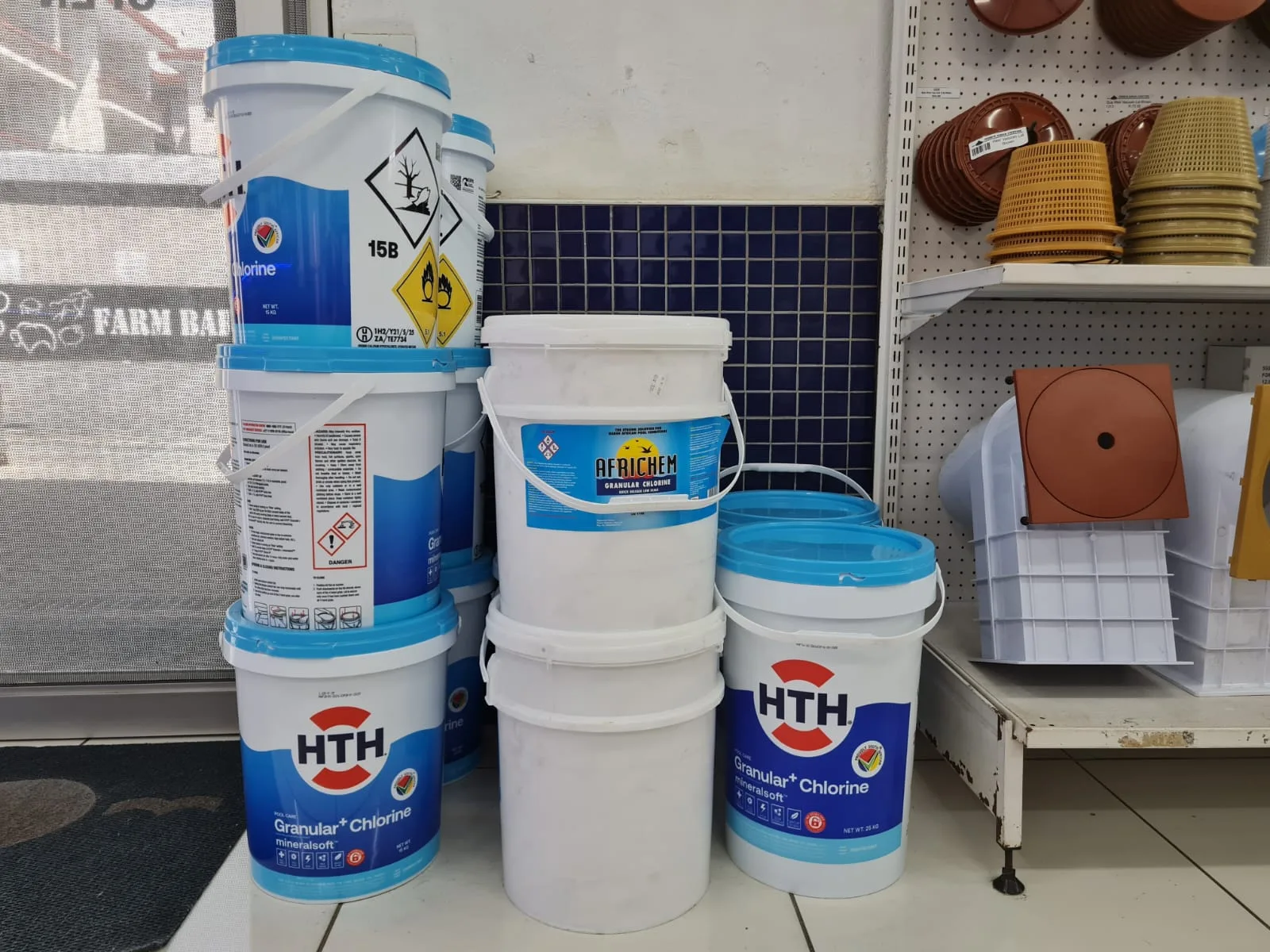
Use HTH granular chlorine (calcium hypochlorite, 65-70% available chlorine) or Africhem granular chlorine. Dissolve it in a bucket of pool water first. Never throw undissolved granules directly into the pool as they can bleach and damage the pool surface. Pour the dissolved solution around the edges of the pool with the pump running.
Shock in the late afternoon or evening. UV light from the sun breaks down chlorine rapidly. By adding it in the evening, you give it a full night of contact time without UV degradation.
Step 5: Run the Filter Continuously
After shocking, run your pump and filter 24 hours a day until the water clears. This is not optional. The filter is what physically removes the dead algae from the water. Without continuous circulation, the chlorine can't reach all the water, and the dead algae just sinks and decomposes.
Check the filter pressure gauge. If pressure rises 8-10 psi above normal (the "clean" reading), the filter is loaded with dead algae and needs to be cleaned:
- Sand filter: Backwash for 3-4 minutes, then rinse for 30 seconds. You may need to backwash daily during recovery.
- Cartridge filter: Remove the cartridge and hose it down. Soak it in a filter cleaning solution overnight if it's heavily loaded.
- DE filter: Backwash and recharge with fresh diatomaceous earth.
Expect to run the pump for 48-72 hours straight on a dark green pool. On a light green pool, 24-36 hours is usually enough.
Step 6: Add Algaecide
Algaecide is a follow-up treatment, not a replacement for chlorine. Add it 24 hours after the shock, once the chlorine level has dropped below 5 ppm. High chlorine deactivates most algaecides, so timing matters.
Use a quality quaternary ammonium ("quat") or copper-based algaecide. We stock HTH and Africhem algaecides at both branches. Dosing for a standard 40,000-litre pool is typically 400-500ml for a quat algaecide, or as directed on the label. Copper-based algaecides are stronger and better suited for severe blooms, but must be dosed carefully as excess copper can stain pool surfaces.
Pour the algaecide around the edges of the pool with the pump running. Continue filtering.
Step 7: Brush Again and Vacuum
By day 2-3, the water should be turning from green to cloudy blue/grey. This means the algae is dead but still suspended. Brush the walls and floor again to dislodge any remaining clumps. Now vacuum the bottom. If your pool is heavily loaded with dead algae sediment, vacuum to waste (bypass the filter) to avoid clogging it. Top up the pool after vacuuming to waste.
Step 8: Clarify
If the water is blue but still hazy after 48 hours, add a pool clarifier (flocculant). This binds the fine particles together so the filter can catch them. Add it with the pump running, then let the pump run for another 8-12 hours. You should see a noticeable improvement within a day.
Alternatively, if you have a sand filter, you can use a concentrated flocculant. Add it, run the pump for 2 hours to distribute, then turn the pump off and let everything settle to the bottom overnight. In the morning, vacuum to waste.
Step 9: Retest and Balance
Once the water is clear, test all parameters: pH, chlorine, alkalinity, and stabiliser. The shock treatment will have thrown things off. You'll likely need to:
- Lower the chlorine if it's still above 3 ppm (just wait, it drops naturally with sunlight and time).
- Readjust pH to 7.2-7.6.
- Top up stabiliser (CYA) to 30-50 ppm if it's low, which is common after heavy backwashing.
- Check calcium hardness if you used a lot of calcium hypochlorite (HTH), as it adds calcium to the water.
Bring a water sample in to either of our branches for a free professional test. We'll confirm everything is balanced and advise on any final adjustments.
Bring in a water sample for free testing
Not sure what's going on with your green pool? Bring in about 500ml of water from elbow depth. We'll test it on the spot, tell you exactly what you need, and give you the correct dosing for your pool size. Free at both branches. No appointment needed.
WhatsApp UsWhy Did the Pool Go Green?
Understanding the cause prevents it from happening again. The most common reasons:
- Chlorine dropped to zero. This is the number one cause. It happens when the pump fails, when you go on holiday, when stabiliser is too low and UV burns through chlorine in hours, or when you simply forget to dose.
- pH was too high. Even with chlorine present, a pH above 7.8 reduces chlorine effectiveness dramatically. The chlorine is there, it just can't work.
- Filter not running enough. In summer, a pool needs 8-10 hours of filtration per day. Cutting it to save on electricity is a false economy when you end up spending R500+ on recovery chemicals.
- High phosphate levels. Phosphates are algae food. They enter the pool from fertiliser runoff, decomposing leaves, and certain fill water sources. A phosphate remover can help prevent recurring algae issues.
- Storm or heavy rain. A big Highveld storm dumps organics, dilutes chemicals, and can shift pH and alkalinity overnight.
Shopping List for a Green Pool Recovery
For a standard 40,000-litre pool that's dark green, here's what you'll typically need:
- HTH or Africhem granular chlorine: 2kg (R180-R280)
- Hydrochloric acid (pool acid): 1 litre (R40-R60)
- Algaecide: 1 litre (R120-R200)
- Clarifier/flocculant: 500ml (R80-R120)
- Test strips or bring a sample in for free testing
Total cost: roughly R400-R650 if you do it yourself. We stock everything you need at both branches. Tell us your pool size and we'll give you the exact quantities.
 Free PDF
 Free Pool Care Guide
Never deal with a green pool again. Get our free care guide with prevention checklists and chemical dosing charts.
- Weekly maintenance checklists
- Chemical dosing charts with ideal ranges
- Seasonal opening and closing prep
- Common mistakes that cost you money
We respect your privacy and comply with POPIA. Unsubscribe anytime.
Related Articles
Pool Maintenance 101: The Complete Guide for SA Pool Owners
Read MoreHow to Test Your Pool Water (And What the Results Mean)
Read MoreNeed pool chemicals or equipment?
Browse our full range of pool chemicals, pool filters, or book a maintenance visit and let us handle the recovery for you.
Your Pool. Sorted.
Whether you need chemicals for a green pool, a new pump, regular maintenance, or advice from someone who has seen it all before. The Trollip family still runs Ridd's. Decades of pool expertise. Two branches. Free water testing. Everything but the water.
Walk in. Call. WhatsApp. We're here.
Ridd's Pool Care App
Track your pool health, service history & water chemistry from your phone.